
Most people who watch Sapne vs Everyone knows Ashwin. They know his stubborn hope, his quiet battles, his refusal to give up. What they don’t always think about is the person playing him — the one who had to understand every crack in that character, every doubt, every small act of courage.
That person is Akhil Kaimal. And his story, in many ways, is just as compelling as the one he performed on screen.
Before Ashwin. Before Netflix. Before Dharma Productions. Before any of it — there was a twenty-three-year-old sitting in a corporate office in Gurugram, trying to ignore a feeling that wouldn’t go away.
Gujarat, Engineering, and a Feeling He Couldn’t Name
Akhil is originally from Kerala, but he didn’t grow up there. He spent over twenty years in Gujarat — childhood in Anand, engineering at Nirma University in Ahmedabad. He was rooted in a place far from the Malayalam cinema he loved. And he loved it deeply. While other kids were watching Bollywood, Akhil was drawn to Malayalam films — their texture, their restraint, the way they told stories that felt real.
He’d stand in front of a mirror at home, mouthing dialogues, pretending. He never called it acting practice. It was just something he did.
College came and that instinct quietly went underground. There’s a particular anxiety that sets in when you’re young and aware of how people perceive you. Drama kids were seen a certain way — not serious, not academic. Akhil didn’t want that label. So he kept his head down, finished his degree, and got placed at a company in Pune. A few weeks into training, he found a new job in Gurugram and moved there as a business analyst.
The job was fine. The weekends weren’t.
One Search. One Decision.
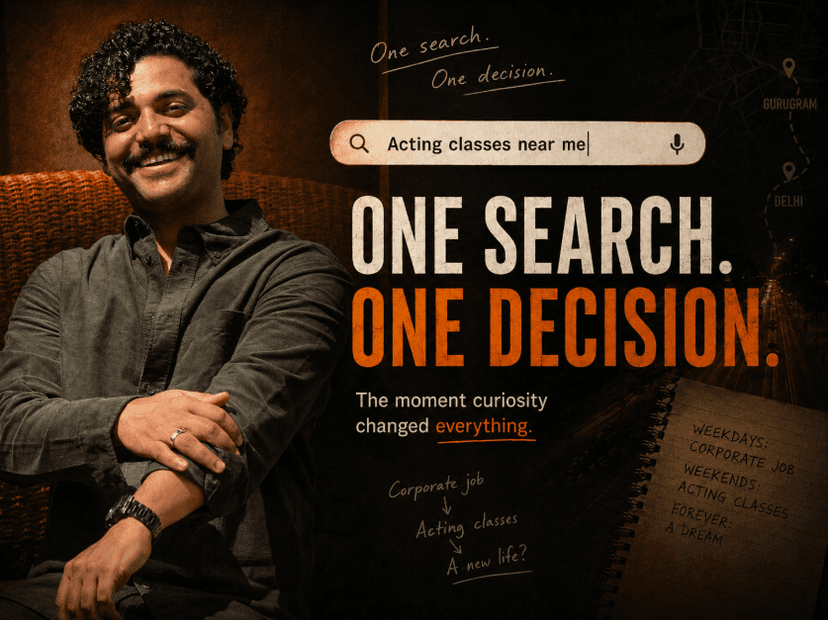
One weekend, almost on a whim, he typed “acting classes near me” into a search bar. He found the Barry John Acting Institute in Delhi. He enrolled. Every Monday to Friday he sat at his corporate desk in Gurugram. Every Saturday and Sunday he took the metro to Delhi and lost himself in something that finally felt right.
“I used to wait for the weekend just to go there,” he says. “Five days in the office, two days actually living.”
When the three-month course ended, the restlessness didn’t. It grew. He started reaching out to Malayalam film productions from Gurugram — an exercise that was, logistically speaking, almost impossible. You can’t fly to Kerala every time someone calls you for an audition. He knew it. But he couldn’t stop trying either.
He also tried Delhi’s theatre scene. But theatre there was a full-time world, not a weekend one. Everyone in those rehearsal rooms had committed entirely. He hadn’t. Not yet.
It took a year and a half of living in that in-between space before he made the call. In 2017, he resigned.
Kerala: A Place He Was From but Didn’t Know
But he didn’t just quit and show up. That wasn’t how he was wired. “I didn’t want to just try randomly,” he explains. “I wanted to actually learn. Properly.” So he gave the entrance exam for an acting school in Thiruvananthapuram, got selected, and moved to Kerala.
Here’s what made it stranger: even though Kerala was “home” on paper, Akhil had never actually lived there. No friends. No social circle. His relatives were far from the parts of the state where the film industry lived. He moved into a shared house and started from zero.After completing his one-year course in Thiruvananthapuram, he made another move — to Kochi, where the Malayalam industry is actually based. Kochi is five to six hours north of Thiruvananthapuram. New city, again. New people, again. Build everything from scratch, again.
There were days he didn’t step outside his room. Not because anything was wrong, but because there was nowhere to go and no one to go with. He’d sit there, record monologues on his phone, practice scenes alone, talk to himself. That became his normal.
The First Shot, the Director’s Anger, and the Chair
His first film after completing the course was Jalsamadhi. There was a close-up shot. The director called action. Akhil did his thing.
Cut. The director explained what he wanted. Then explained again. Then a third time. It still wasn’t landing the way he envisioned it. His frustration surfaced: “You’ve been to a film institute. This should be basic. Should I come and show you myself?”
Akhil, not yet knowing the unspoken language of sets, responded honestly: “Yes, sir, please.”
That made things worse. “Then why did I hire you? I’d do it myself.” And then everyone around — the cinematographer, the crew, people just standing nearby — started chiming in with their own advice. Each one demonstrating, each one trying to help, each one adding to the noise.
Akhil got through the scene. Somehow. But his mind had gone completely blank. Nothing the director said after that first cut was getting through. The scene wasn’t even technically difficult — that’s what stung the most when he thought about it later. It was the pressure that shut him down, not the work itself.
He went and sat down after the shot was done. Quietly turned the incident over in his mind. What happened? Why couldn’t I deliver? And slowly, sitting there, it became clear: it wasn’t about ability. It was about the environment collapsing around him all at once.
That shoot wasn’t a one-off either. Something like it happened almost every day on that film. Small moments, big moments, each one chipping away at whatever confidence he’d carried in from acting school.
“Your first project — you’ve just finished learning, you’re hopeful — and then you hear all of that. It shakes you. You start asking yourself: am I good enough? Do I actually know anything?”
But he kept going. He told himself it was the first experience, that this is how you learn, that no amount of training fully prepares you for a real set. He took the hit, accepted it, and moved forward. That decision to keep going despite being shaken — it would become a pattern he’d rely on many times after.
COVID, Isolation, and the One Companion Who Never Left
Then came COVID. Kerala was one of the first states to go into lockdown — before the national announcement. One by one, everyone in Akhil’s building packed up and went home. He stayed.
For four to five months, in a building that had gone from full to near-empty, he was the only person on his floor. His grandparents were in Kerala, but visiting felt too risky. So he didn’t go. He stayed in his room. Alone.
He says those months weren’t the darkest. What they were was clarifying. He had always needed people around him — back in Gurugram, the idea of being alone felt impossible. But somewhere in those long, quiet months in Kerala, something shifted. He started to genuinely enjoy his own company. Not out of resignation. Out of discovery.
“In my early days in Kerala, something would happen and I’d get emotional and start crying. But then I’d notice myself crying — actually observing it — and suddenly I was no longer in the emotion. I’d forget why I was crying. That’s what trying to understand your craft does to you. It teaches you to watch yourself.”
The Move to Mumbai, and the Work That Came Before It
Over those years in Kerala, people around him — mentors, colleagues, friends — kept nudging him toward Mumbai. “Your Hindi is good. The industry there will open up for you. Here it’s difficult if you don’t have connections.” He resisted for a long time. Malayalam cinema was the dream. He wasn’t ready to let it go.
But the Malayalam industry runs on tight, established circles. Crews tend to work with the same people repeatedly. For someone who described himself as a little introverted, a little socially awkward, with no existing network, breaking in felt like pushing against a wall that kept moving.
When his father’s health declined, he came back to Anand. And that time away became its own turning point. He made the decision. He’d go to Mumbai. But not empty-handed — he reached out to a contact and landed a job as a casting assistant at CastingBay before he even arrived, working his way up to associate within months. He didn’t want to sit idle. He wanted to be useful, to keep learning, to keep being inside the industry even while waiting for his own moment.
What followed was a slow, deliberate climb. He arrived in Mumbai still doing theatre, with two Kerala films already behind him. Ads started coming in. And then, one project at a time, the screen presence grew.
It started with Asur 2 — one scene, no character name, what the industry calls a tertiary role. Two or three dialogues. Barely there. But he was in the room.
From Asur 2 came The Kerala Story, where he finally had a character name. Still only two or three scenes, still not a big role. But a name. A presence.
Then The Trial and Kaala Paani, where something shifted. He wasn’t just in scenes anymore — he had an arc. An entire episode built around his character. From one scene to a character. From a character to a story.
Kapkapi and The Hunt came next. In Kapkapi, he was there until the interval. In The Hunt, across three or four episodes. The roles were getting longer, the characters were getting heavier.
And then Sapne vs Everyone — where he was present across every episode. The full journey, in one show.
“One scene to a character, to a character having a full episode, to three or four episodes, to the whole show. That was the progression.”
Running alongside all of this, quietly and consistently, were the things he did because he genuinely wanted to — not because they were stepping stones. He shot Stains, a short film that came out of a National Institute of Design diploma project in Ahmedabad, which dealt with menstruation taboos and how even the people closest to us can fail to understand. He was the boyfriend in that film. It’s a short film he’s proud of. He also did I Am An Actor and Vichaar Maithun.
On stage, he performed in two plays that mattered to him. One was Middle Class Dream of a Summer’s Night — an adaptation of Shakespeare’s A Midsummer Night’s Dream. The other was Kare Toh Kare Kya, Bole Toh Bole Kya.
None of this was a strategy. It was just what he did. Working, learning, showing up.
Ashwin, and the People Who Made Him Possible
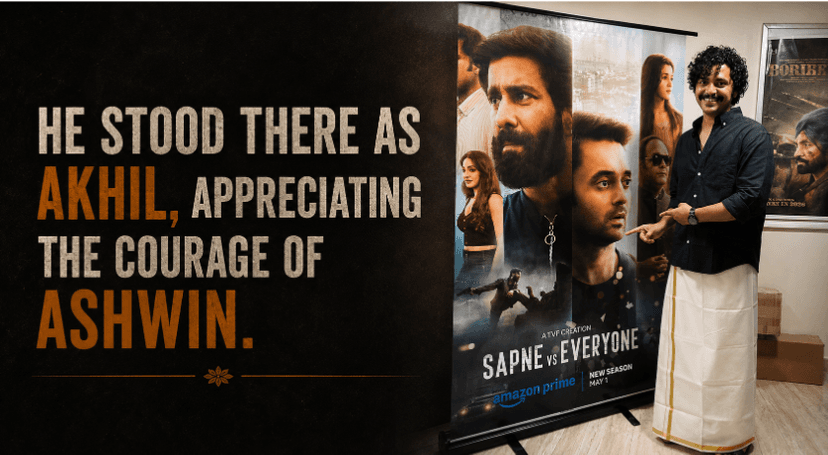
When Sapne vs Everyone came along, audiences saw Ashwin — a character trying to survive and stay in the game despite everything stacked against him. What they were actually watching, without knowing it, was someone who had lived a version of that fight.
Akhil has said that he identifies with each character in the show — not just Ashwin but also Prashant’s hustle, Manish’s feelings, even Jimmy’s flashes of anger. Because as a person navigating an unlikely path, he’s been through versions of all of it.
He holds a particular belief about what makes acting work: “If you can’t empathise with people, you can never be an actor. You have to understand where someone else is coming from. Not just the character — people, in general.”
He also doesn’t forget who was there with him before this became a success story. He’s careful to draw the line between the healthy self-reliance he found in those solitary years and the people who quietly held space for him along the way. Both things are true. Both things matter to him.

What He Actually Carries
The 2026 version of Akhil Kaimal — recognised, working with major productions, building a career many aspire to — is not a story that started with talent and a lucky break. It started with a twenty-three-year-old who walked away from a stable salary, moved to a state he’d never really lived in, spent years in rooms he barely left, worked through a pandemic alone, stood frozen on a film set while everyone around him gave advice, and then sat down, figured out what went wrong, and got back up.
At every stage, someone gave him a reason to stop. The first rejection. The isolation. The industry walls. The pandemic. His own doubt.
He didn’t.
And that, more than any role he’s played, is the most honest version of who he is.
Filmography: Sapne VS Everyone • Chand Mera Dil • The Kerala Story • Kaala Paani • The Trial • Asur 2 • Kapkapi • The Hunt • Jalsamadhi • Short films: Stains, I Am An Actor, Vichaar Maithun • Theatre: Middle Class Dream of a Summer’s Night, Kare Toh Kare Kya Bole Toh Bole Kya
There is one more thing worth saying.
When someone with no following, no platform, and no obvious reason to be given time reached out to him, Akhil responded. He showed up to the conversation, spoke honestly, shared what he had learned, and encouraged me to keep going. No hesitation. No conditions.
That is not a small thing. People at a certain level of recognition develop a habit of protecting their time, and understandably so. But Akhil didn't calculate the exchange. He just showed up — the same way he always has.
Because sometimes it really is that simple. He replied. You talk. You say the thing that might matter to someone who is still at the beginning.
This article is only a glimpse of what he has built so far. The journey is very much continuing — and if the years behind him are any indication, what lies ahead will only add to it.